Aboriginal Art Glossary: Understanding Essential Terms for Enthusiasts and Collectors
Discover the essential vocabulary of Australian Aboriginal art with Inma Galerie, your specialist in contemporary Aboriginal art. This comprehensive guide will help you better understand and appreciate Aboriginal paintings.
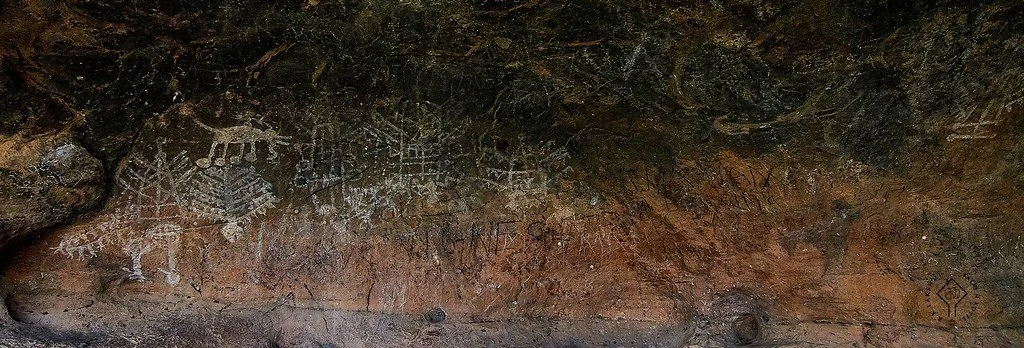
Fundamental Symbols of Australian Aboriginal Art: Understanding the Ancestral Visual Language to Better Appreciate Aboriginal Paintings - Inma Galerie Guide
Introduction: Why an Aboriginal Art Glossary?
Australian Aboriginal art possesses a specific vocabulary that can seem complex to novice enthusiasts. Understanding these essential terms will allow you to fully appreciate the cultural and spiritual richness of Aboriginal paintings. At Inma Galerie, we believe that greater knowledge enriches the collecting experience and strengthens the connection with these exceptional Aboriginal artworks.
This comprehensive glossary covers the geographical, cultural, technical, and spiritual terms you will encounter when acquiring Aboriginal paintings. Whether you are a novice collector or an enlightened enthusiast, this guide will become your reference for navigating the fascinating world of Aboriginal art.
A - Terms Beginning with A
Aboriginal / Aboriginal
The term "Aboriginal" (from the Latin ab origine meaning "from the origin") refers to the first inhabitants of Australia, present on the continent for over 65,000 years. In the artistic context, "Aboriginal art" refers to the visual expressions of Aboriginal Australian peoples, whether traditional or contemporary.
Spelling Note: The spelling "arborigène" is sometimes found, but "aborigène" is the correct and preferred form in Australian Aboriginal art.
Awelye
Awelye ceremonies are sacred rituals reserved for Aboriginal women. These ceremonies include songs, dances, and body painting. Many Aboriginal artists, such as Emily Pwerle, represent Awelye motifs in their Aboriginal paintings, creating a direct link between ritual and contemporary art.
Awelye motifs can only be painted by initiated women from the appropriate clans, ensuring the cultural authenticity of the artworks.
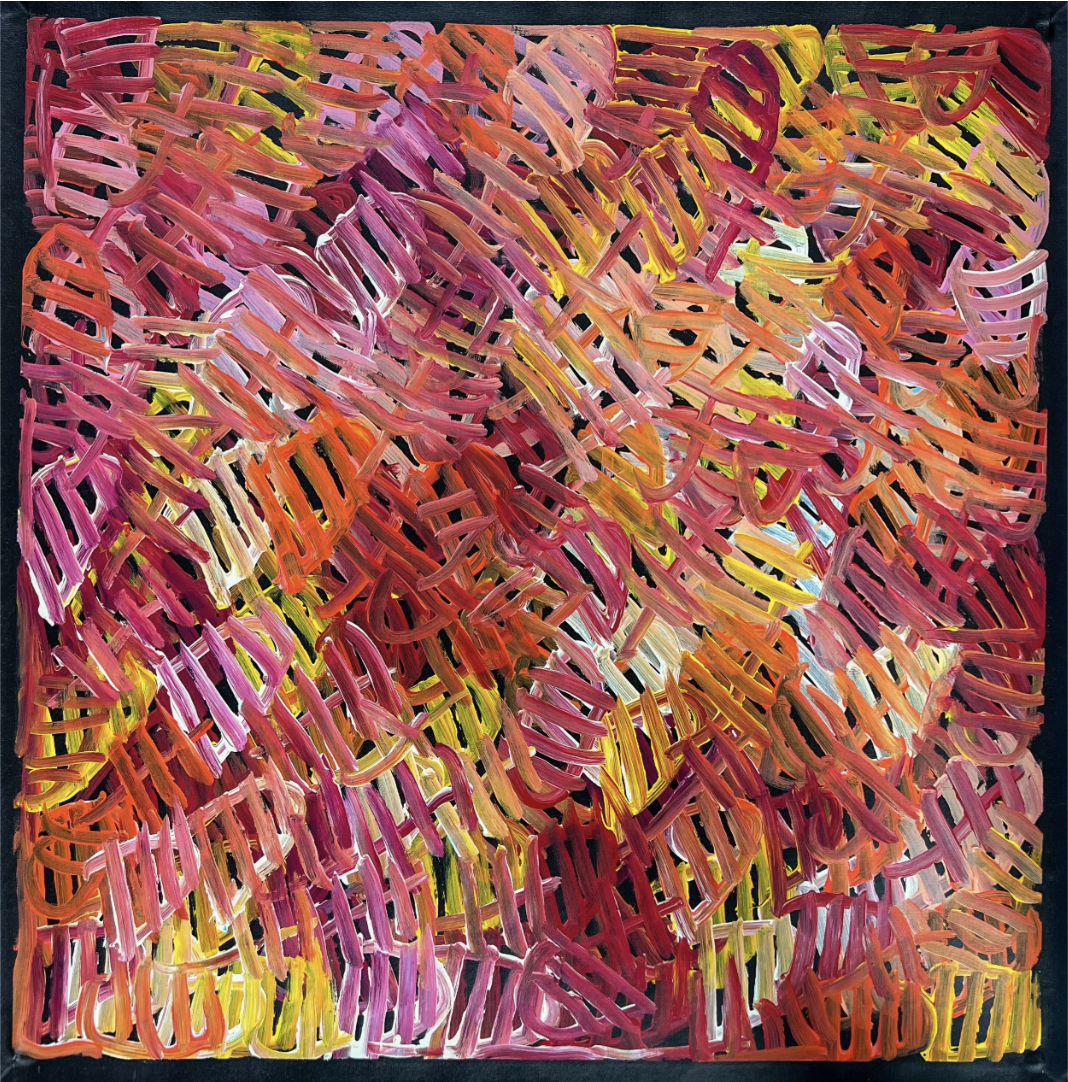
Representation of Awelye ceremonies in Emily Pwerle's Aboriginal art: sacred female body motifs passed down through generations - Artwork available at Inma Galerie
Acrylic
Acrylic is the primary medium used in contemporary Aboriginal art since the 1970s. Before the introduction of acrylic paint, Aboriginal artists used natural pigments (ochres, charcoals) on bark, stone, or sand. Acrylic has allowed for better preservation and international commercialization of Aboriginal paintings.
APY Lands (Anangu Pitjantjatjara Yankunytjatjara)
The APY Lands constitute a vast region in northwestern South Australia, the traditional territory of the Anangu peoples. This area produces some of the most highly sought-after Aboriginal paintings, notably those from the communities of Amata, Mimili, and Indulkana. Inma Galerie features exceptional works originating from the APY Lands.
Anmatyerre / Alyawarre
The Anmatyerre and Alyawarre are two related linguistic groups from the Utopia region. Many celebrated Aboriginal artists, such as Emily Pwerle and Gloria Petyarre, belong to these peoples. Their Aboriginal art is characterized by vibrant compositions connected to women's ceremonies.
B - Terms beginning with B
Bush
The term "bush" refers to the wild, sparsely populated lands of the Australian interior. In Aboriginal art, "bush" appears in expressions such as "Bush Leaves" (medicinal leaves from the bush) or "Bush Tucker" (traditional food). The artist Gloria Petyarre is renowned for her Bush Leaves paintings available at Inma Galerie.
Bush Tucker
Bush Tucker (or Bush Food) refers to all edible plants and animals found in the Australian bush. Seeds, berries, yams, grubs, and other traditional foods are frequently depicted in Aboriginal paintings as symbols of survival and connection to the land.
Batik
Batik is a fabric dyeing technique practiced in Utopia during the 1970s-1980s. Many Aboriginal artists, such as Gloria Petyarre, initially worked with batik before transitioning to acrylic on canvas. These historic batiks are now highly sought after by collectors of Aboriginal art.
C - Terms beginning with C
Ceremonies / Ceremonial
Aboriginal ceremonies are spiritual rituals that maintain connection to the Dreaming and transmit cultural knowledge. Aboriginal paintings often depict these ceremonies: initiations, fertility rituals, and seasonal celebrations. Only initiated individuals are permitted to paint specific ceremonies.
Concentric Circles
They generally represent:
Waterholes (vital sources in the desert)
Ceremonial sites
Campsites
Holes dug for searching for food
The exact interpretation depends on the narrative context of each Aboriginal painting.
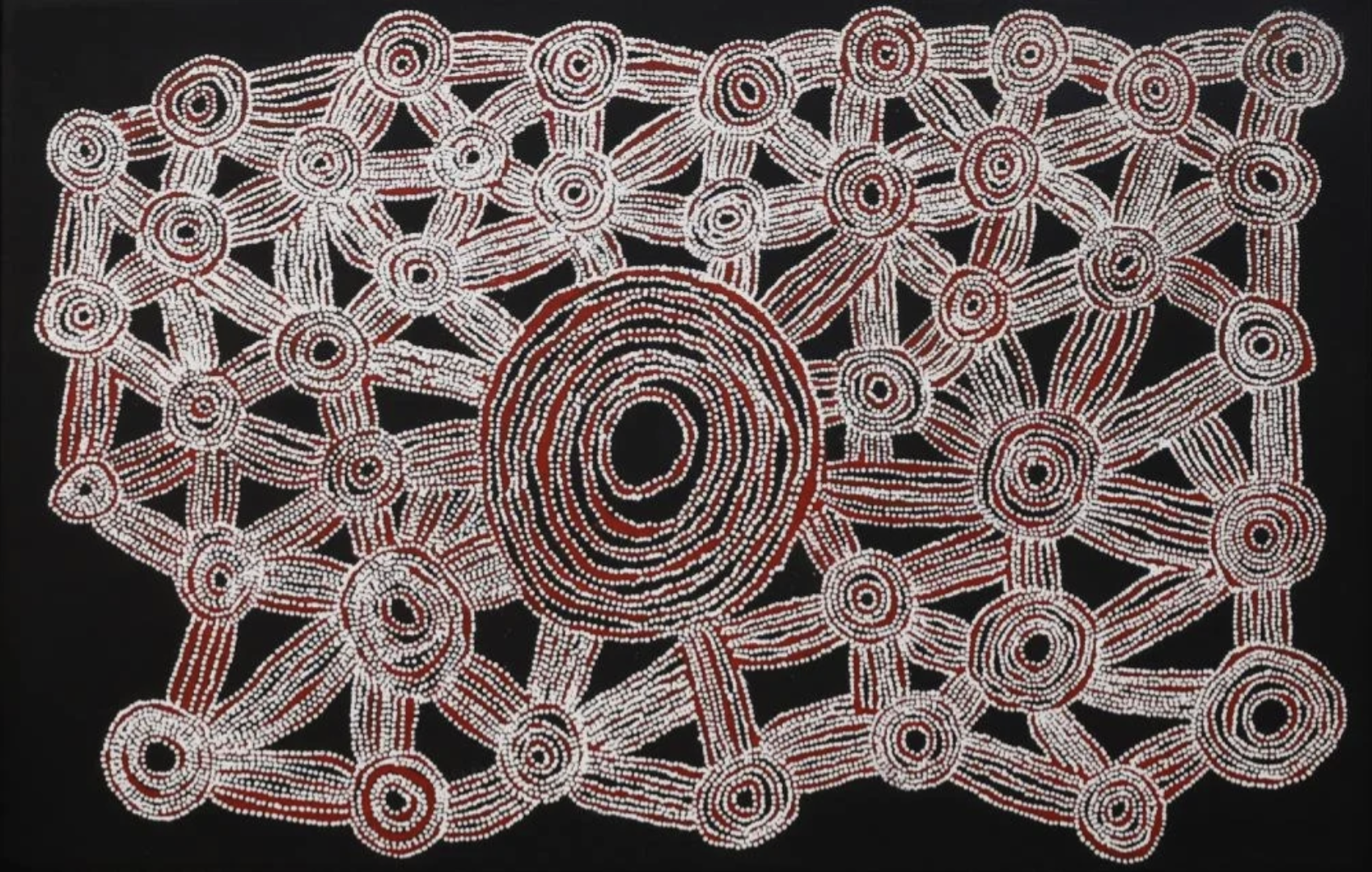
Concentric circles: a fundamental symbol in Aboriginal art representing waterholes, sacred sites, and gathering places - Painting by Wentja Morgan Napaltjarri, Inma Galerie Collection
Clan / Skin Group
Clans or skin groups are complex social divisions that determine family relationships, ceremonial responsibilities, and rights over certain Dreaming narratives. Only members of specific clans are permitted to paint certain stories. For example, only women from the Pwerle or Kemarre clans can paint certain Awelye designs.
Traditional Colors
The traditional colors of Aboriginal art come from natural pigments:
Red and yellow ochres: iron oxide
White: kaolin (white clay)
Black: charcoal
Earth: various clays
Contemporary Aboriginal art uses acrylics but often draws inspiration from these traditional palettes.
D - Terms beginning with D
Dreaming / Dreamtime
The Dreaming (or Dreamtime) is the central spiritual concept of Aboriginal culture. It refers to:
The era of the world's creation by the Ancestors
The spiritual and social laws established by these Ancestors
The perpetual connection between past, present, and future
The mythological narratives that explain the formation of the landscape
Each Aboriginal painting tells a Dreaming story. At Inma Galerie, we document the Dreaming narrative associated with each Aboriginal painting.
Important note: The term "Dreamtime" wrongly suggests that the Dreaming belongs to the past. "Dreaming" is preferable as it emphasizes the temporal continuity of the concept.
Dots / Aboriginal Pointillism
Dots (points) are the most iconic technique in contemporary Aboriginal art. This Aboriginal pointillism technique involves applying thousands of acrylic paint dots to create complex patterns.
Origins: Initially, dots were used to conceal sacred information from the uninitiated. Today, they form a recognizable aesthetic of Aboriginal art.
Dots can represent:
Seeds and food
Stars in the night sky
Flames of fire
Footprints in the sand
Simple decorative elements enriching the composition
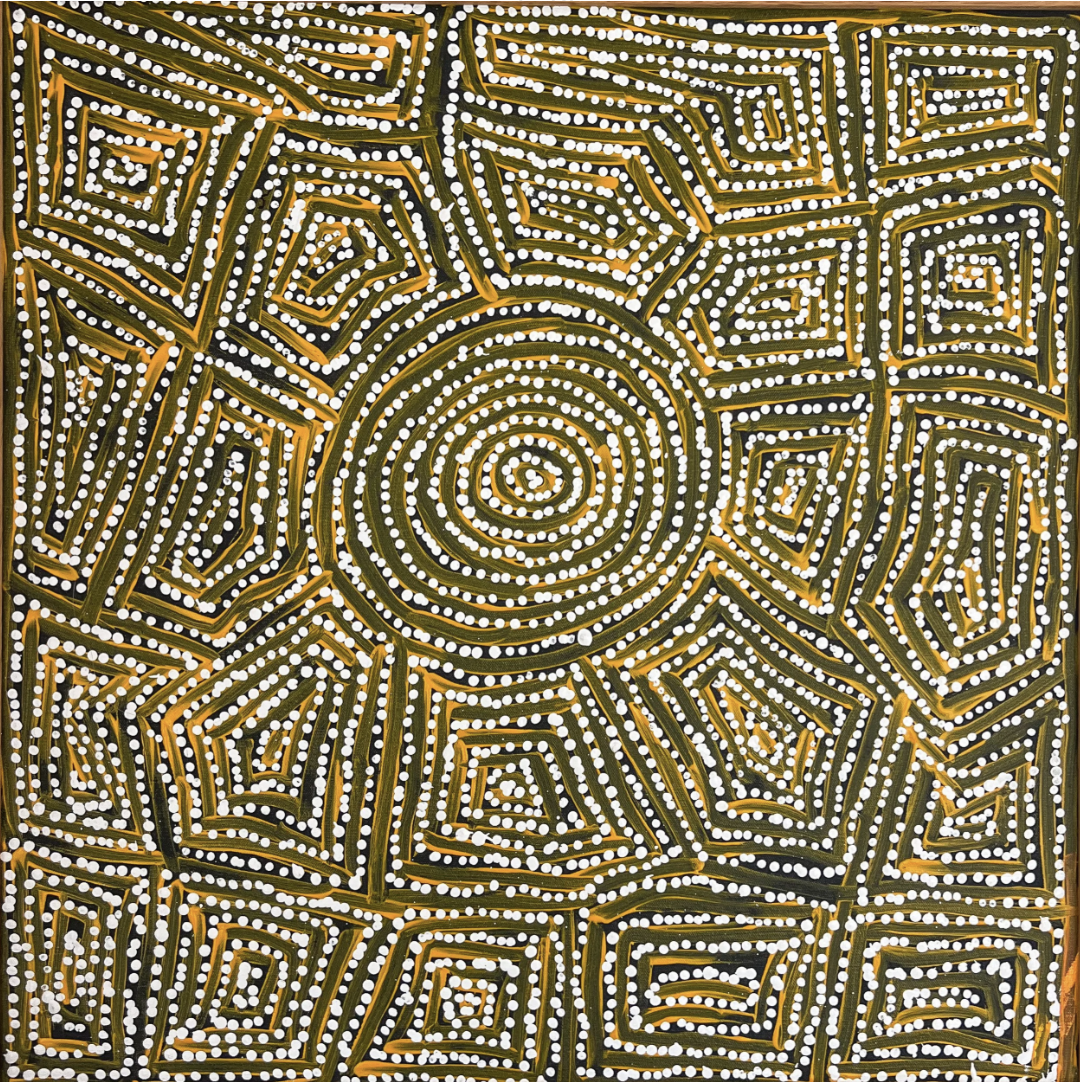
The dots technique (Aboriginal pointillism): thousands of dots creating colorful vibrations and narrative depth - Detail of a work by George Ward Tjungurrayi, Inma Galerie Collection
Central Desert / Central Desert
The Central Desert (Central Desert) refers to the vast arid region in central Australia, including the Gibson, Simpson, Tanami, and Great Victoria Deserts. This region has produced some of the most significant Aboriginal artists.
Major art communities include:
Papunya: birthplace of the contemporary Aboriginal art movement (1971)
Utopia: community of Gloria Petyarre, Emily Kame Kngwarreye
Kintore: region of Wentja Morgan Napaltjarri
Yuendumu: important Warlpiri community
Inma Galerie specializes in Aboriginal art from the Central Desert.
E - Terms beginning with E
Bark / Bark Painting
Bark paintings are traditional in northern Australia, particularly in Arnhem Land. Aboriginal artists paint on the inner bark of the stringybark eucalyptus. Although different from the acrylic Aboriginal art of the desert, bark painting is a major form of Aboriginal expression.
Emu
The emu is one of the most frequently depicted totemic animals in Aboriginal art. This flightless bird appears in many Dreaming narratives. Emu tracks (three-toed footprints) are a common motif in Aboriginal paintings.
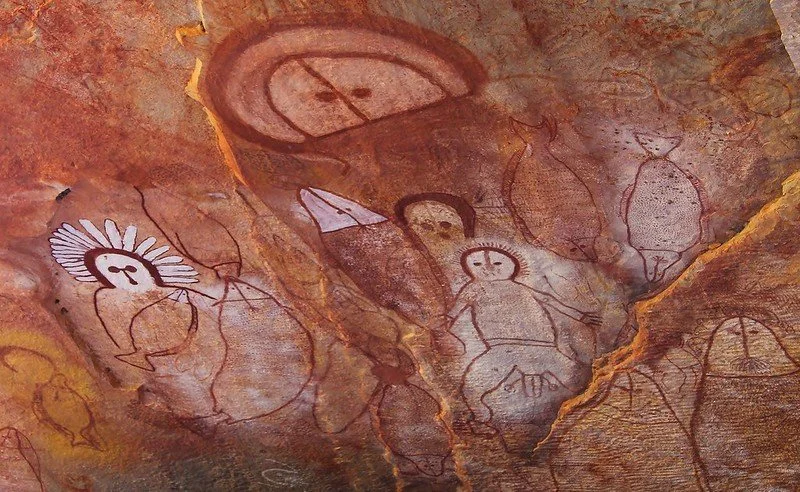
Animal symbols in Aboriginal art: emu, lizard, rainbow serpent
G - Terms beginning with G
Gallery / Art Centre
Art centres are community organizations managed by Aboriginal peoples that support Aboriginal artists. They provide materials, workspace, documentation, and ethical marketing. Key art centres include Papunya Tula Artists, Utopia Artists, Tjungu Palya.
Inma Galerie works directly with these art centres to guarantee the authenticity and ethical provenance of each Aboriginal painting.
Gibson (Desert)
The Gibson Desert is an arid region in Western Australia. It is the traditional land of the Pintupi people, including Wentja Morgan Napaltjarri. Aboriginal art from this region is characterized by compositions related to waterholes and ancestral journeys across the desert.
I - Terms beginning with I
Initiation
Initiation ceremonies mark the transition to adulthood and the transmission of sacred knowledge. Some Aboriginal paintings depict elements of these ceremonies, although the most sacred details remain hidden from the uninitiated.
Yam / Yam
The yam (igname in French) is an edible tuber plant crucial in traditional diets. The Yam Dreaming frequently appears in Aboriginal art, particularly the pencil yam (bush yam or pencil yam). These tubers are represented by elongated forms in Aboriginal paintings.
K - Terms beginning with K
Kapi / Waterhole
Kapi (Pintupi term) refers to waterholes essential for survival in the desert. These water sources – rockholes, springs, temporary pools – are sacred sites in the Dreaming. They appear as concentric circles in Aboriginal art.
Precise knowledge of kapis allowed desert peoples to survive during seasonal movements. Each waterhole holds its own Dreaming stories.
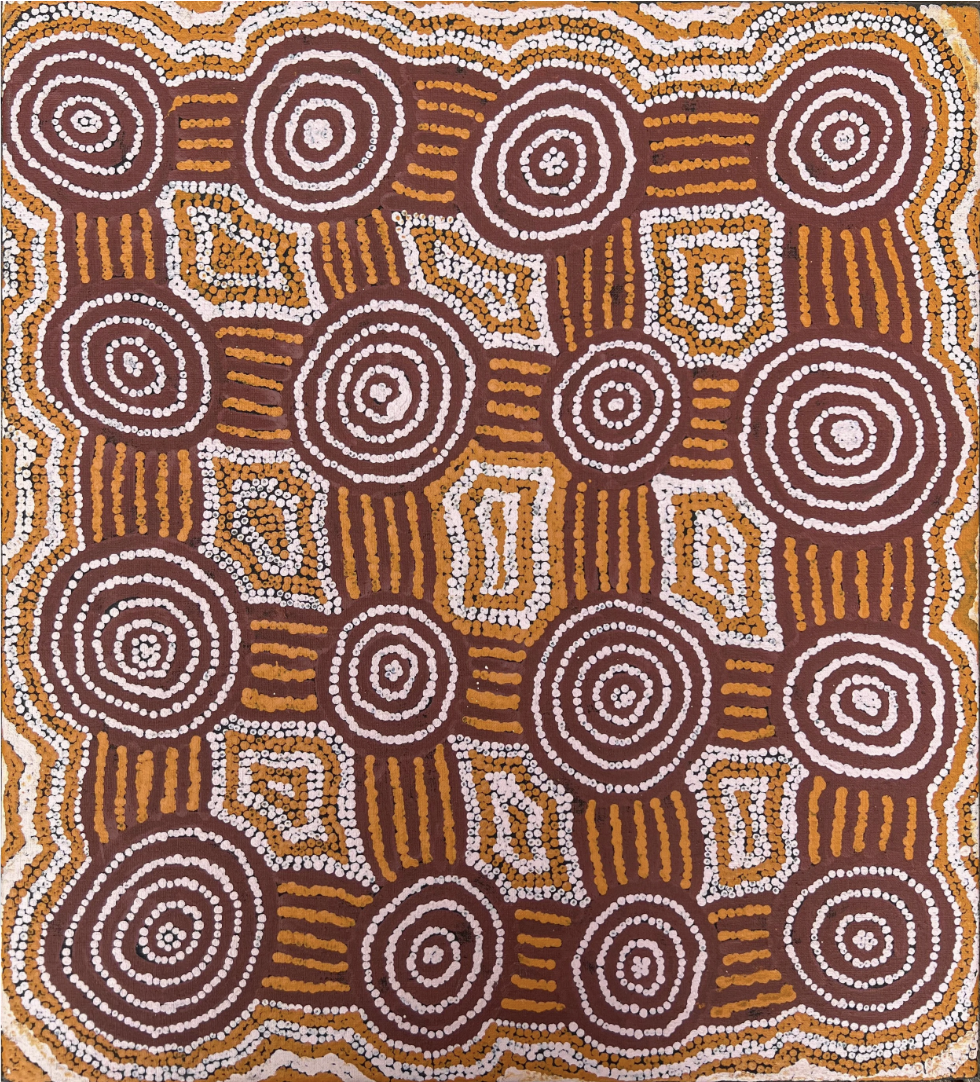
Spiritual mapping: network of waterholes (kapis) and ancestral paths in Aboriginal art – Aboriginal paintings as maps of the Dreaming. Painting by Barney Campbell Tjakamarra.
Kimberley
The Kimberley region, in northwest Australia, boasts a distinct artistic tradition. The Wandjina and Gwion Gwion rock paintings of the Kimberley are among the oldest human artistic expressions. Contemporary Aboriginal art from the Kimberley differs stylistically from that of the Central Desert.
L - Terms beginning with L
Lines
Lines in Aboriginal art hold multiple meanings:
Ceremonial body paintings
Dance tracks in the sand
Paths traveled by Ancestors
Rain falling from the sky
Plant roots underground
Artists like Emily Pwerle are renowned for their dynamic and expressive line compositions. Inma Galerie offers exceptional works utilizing this technique.
Lizard
The lizard frequently appears in Aboriginal art, particularly the Blue Tongue Lizard (Blue Tongue Lizard). Wentja Morgan Napaltjarri regularly painted this totem. Lizards are important creatures of the Dreaming, associated with desert survival.
M - Terms beginning with M
My Country
"My Country" is a frequent title for Aboriginal paintings. It indicates that the artist is painting their traditional territory – the land for which they are the spiritual custodian. Kudditji Kngwarreye primarily used this title, affirming his connection to his ancestral country near Kintore.
The concept of "country" in Aboriginal culture extends far beyond mere geography: it is a living spiritual entity for which one is responsible.
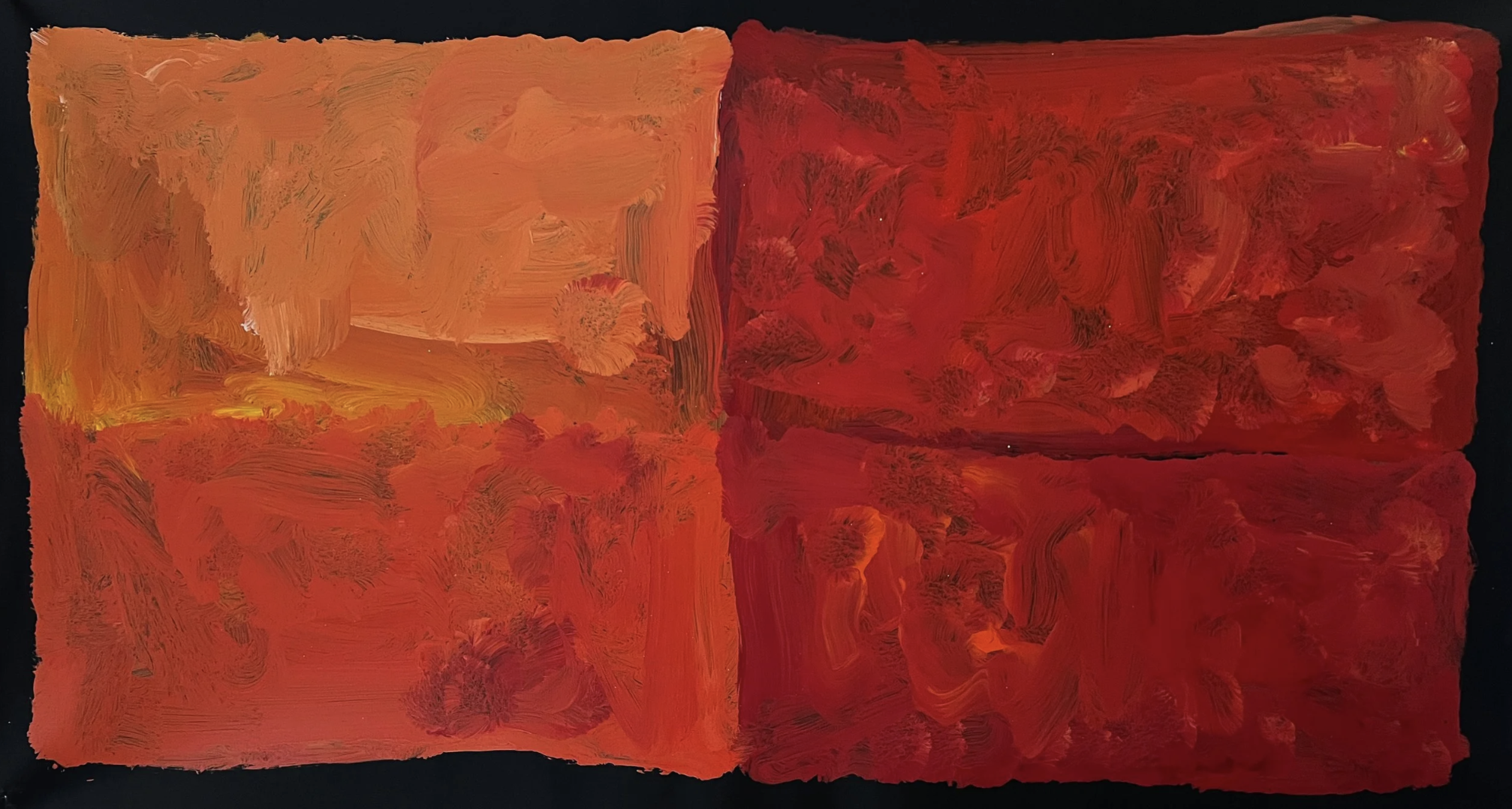
"My Country": aerial vision of ancestral territory in Aboriginal art – Each artist paints their country, for which they are the spiritual custodian – Work by Kudditji Kngwarreye available at Inma Galerie
Motifs / Patterns
Motifs in Aboriginal art are never purely decorative: they always possess a narrative or spiritual significance. Key motifs include:
Concentric circles (sacred sites)
Wavy lines (snakes, rivers)
U-shaped prints (seated people)
Aligned dots (journeys, tracks)
Horseshoe shapes (boomerangs, coolamon)
N - Terms beginning with N
Napaltjarri / Napangardi / Napanangka / Nampitjinpa
These terms are female skin names within the Warlpiri system. Each person inherits a skin name that determines their social relationships and ceremonial responsibilities. Many Aboriginal artists bear these names: Wentja Morgan Napaltjarri, Judy Watson Napangardi, Lorna Ward Napanangka.
Corresponding male skin name system: Tjapaltjarri, Tjangala, Tjampitjinpa, Tjungurrayi.
O - Terms beginning with O
Ochre
Ochre refers to natural iron oxide-based pigments traditionally used in Aboriginal art. Red, yellow, and brown ochres come from specific sites with spiritual significance. Although contemporary Aboriginal art primarily uses acrylics, palettes often draw inspiration from traditional ochre colors.
P - Terms beginning with P
Papunya
Papunya is the birthplace of the contemporary Aboriginal art movement in 1971. Under the guidance of Geoffrey Bardon, Pintupi, Luritja, Warlpiri, and Arrernte men began painting their Dreaming stories on canvas. The Papunya Tula Artists collective remains one of the most prestigious Aboriginal art centers.
Clifford Possum Tjapaltjarri, one of the founders, is today considered one of the greatest Aboriginal artists of all time.
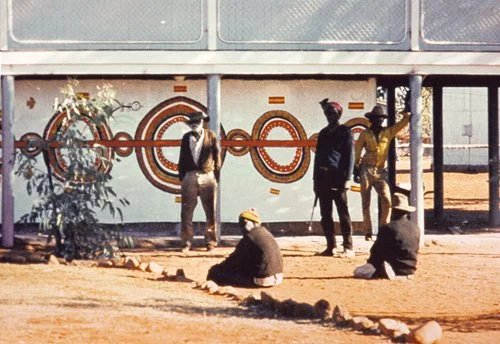
Papunya 1971: Birth of the Contemporary Aboriginal Art Movement - The Pioneers Who Revolutionized Australian Aboriginal Art
Body Painting
Body painting is an essential ceremonial practice. Patterns painted on the body with ochres and fats identify clan, status, and ceremonial role. Many contemporary Aboriginal paintings depict these body motifs, transferring sacred designs from the body to the canvas.
Pintupi
The Pintupi are a Western Desert people, traditionally nomadic in the Gibson and Tanami deserts. Their Aboriginal art is characterized by geometric compositions related to journeys across the desert and waterholes. Kudditji Kngwarreye and his sister Emily Kame Kngwarreye belonged to the Pintupi people.
Pointillism / Dot Painting
See Dots above. Aboriginal pointillism has become the most recognizable aesthetic in Aboriginal art, although not all styles employ it. Artists like Kudditji Kngwarreye have deliberately moved away from pointillism towards more gestural brushwork styles.
S - Terms beginning with S
Rainbow Serpent
The Rainbow Serpent is one of the most powerful creatures of the Dreaming. This giant creator serpent, associated with water, fertility, and the seasons, appears in the mythologies of many Aboriginal peoples. Aboriginal paintings often depict it as a sinuous form traversing the composition.
Sisters Dreaming
Sisters Dreaming (Dream of the Seven Sisters) is a major Dreaming narrative recounting the story of seven sisters pursued across the sky by a man. They become the stars of the Pleiades. This narrative frequently appears in Aboriginal art, particularly in the APY Lands.
Aboriginal Symbols
Aboriginal symbols form a codified visual language. Main symbols:
Circle: waterhole, sacred site, campsite
Inverted U: seated person
Wavy line: snake, river, lightning
Straight line: journey, track, spear
Arc: boomerang, coolamon (container)
Spiral: whirlpool, tornado, spiritual journey
T - Terms beginning with T
Tingari
The Tingari cycle is a complex body of Dreaming narratives belonging to the Pintupi people. These stories recount the journeys of ancestral beings across the desert, shaping the landscape and establishing laws. Tingari narratives are generally secret, with only initiates knowing all the details. Wentja Morgan Napaltjarri frequently painted the Tingari cycle.
Tjukurrpa
Tjukurrpa is the Pitjantjatjara term for "Dreaming". It is equivalent to the concept of Dreaming/Dreamtime, referring to both the creation era and the ongoing spiritual laws.
Totem
A totem is an animal, plant, or natural phenomenon with which a person or clan has a hereditary spiritual connection. The totem determines certain ceremonial responsibilities and restrictions (e.g., not consuming the totemic animal). Aboriginal paintings frequently depict the artists' totems.
U - Terms beginning with U
Utopia
Utopia is an Aboriginal community located 350 km northeast of Alice Springs. This region has produced some of the greatest female Aboriginal artists: Emily Kame Kngwarreye, Gloria Petyarre, Emily Pwerle, the Petyarre sisters. Aboriginal art from Utopia is characterized by vibrant compositions linked to women's Awelye ceremonies.
Inma Galerie specializes in Aboriginal art from Utopia and offers an exceptional collection by artists from this legendary region.
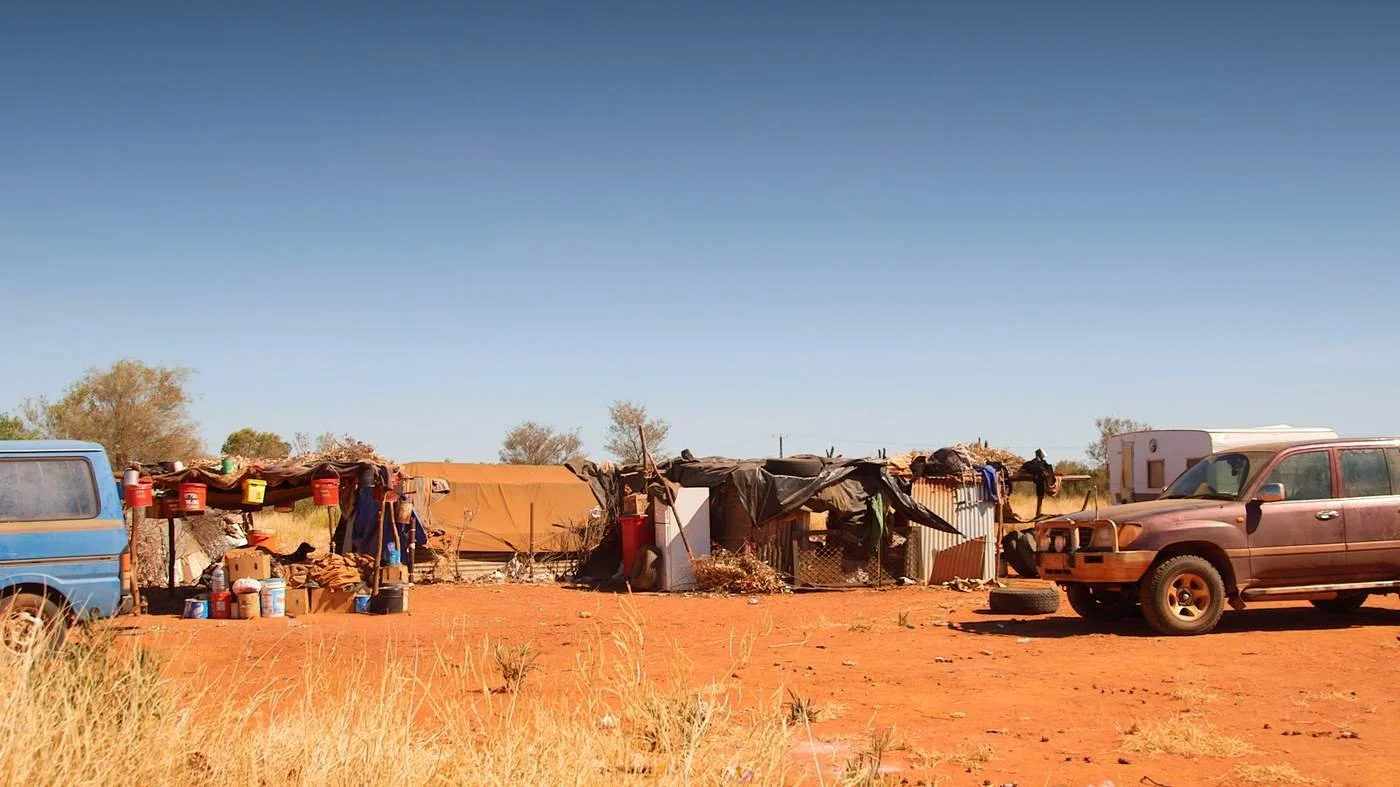
Utopia: Legendary Community of Australian Female Aboriginal Art - Land of Emily Kame Kngwarreye, Gloria Petyarre, and Emily Pwerle - Inma Galerie Collection
W - Terms beginning with W
Warlpiri
The Warlpiri are an Aboriginal people of the central desert, primarily around Yuendumu. Their Aboriginal art is characterized by complex geometric compositions and the use of the skin names system (Napaltjarri, Tjapaltjarri, etc.).
Wynne Prize
The Wynne Prize is one of Australia's most prestigious art awards. In 1999, Gloria Petyarre became the first Aboriginal artist to win this prize, forever transforming the perception of Australian Aboriginal art as legitimate contemporary art.
Conclusion: Deepen Your Knowledge with Inma Galerie
This lexicon provides you with the essential tools to understand and appreciate Australian Aboriginal art. Each term opens a window into the cultural, spiritual, and artistic richness of Aboriginal peoples.
At Inma Galerie, we believe that a deeper understanding enriches the collecting experience. Each Aboriginal painting we offer is accompanied by:
Detailed documentation about the artist
An explanation of the Dreaming narrative depicted
A certificate of authenticity
A guide to the symbols found in the artwork
Additional Resources from Inma Galerie
Our Support Services
Personalized consultations: Our team guides you in understanding Aboriginal art
Virtual tours: Discover our collection of Aboriginal art online
Specialized blog: Receive in-depth articles on Australian Aboriginal art
Inma Galerie Collection
Our gallery offers a curated selection of Aboriginal paintings from:
Utopia: Emily Kame Kngwarreye, Gloria Petyarre, Emily Pwerle
The Gibson Desert: Wentja Morgan Napaltjarri, Kudditji Kngwarreye
Papunya: Historic and contemporary artworks
The APY Lands: Emerging and established artists
Each Aboriginal painting is authenticated, documented, and accompanied by its complete ethical provenance.