Symbols in Aboriginal Art: Decoding the Ancestral Visual Language
Explore the fascinating symbolic language of Australian Aboriginal art and learn to decipher the traditional motifs that narrate 65,000 years of ancestral stories. A complete guide for enthusiasts and collectors by Inma Galerie.

The Fundamental Symbols of Australian Aboriginal Art: circles (waterholes), lines (paths), inverted U-shapes (people) - Learn to decipher Aboriginal paintings with Inma Galerie
Introduction: Understanding Aboriginal Symbols to Appreciate the Art
Aboriginal symbols form a sophisticated visual language that has allowed Australian Aboriginal peoples to transmit stories, laws, and knowledge for over 65,000 years. Each Aboriginal painting is far more than an aesthetic composition: it is a codified narrative where every motif, every shape, every color holds a precise meaning rooted in the Dreaming (Dreamtime).
Understanding these symbols in Aboriginal art radically transforms the viewer's experience. What might appear abstract or purely decorative suddenly reveals spiritual maps, mythological narratives, sacred ceremonies, and millennia-old ecological knowledge. At Inma Galerie, specialists in contemporary Aboriginal art, we believe this knowledge profoundly enriches the appreciation and collection of Australian Aboriginal art.
This comprehensive guide will enable you to decode the most frequent Aboriginal motifs, understand their cultural context, and fully appreciate the Aboriginal paintings in our exclusive collection.
Origin and Function of Symbols in Aboriginal Art
An Ancient Pictographic Language
Aboriginal symbols are not a recent invention linked to the commercialization of contemporary Aboriginal art. They constitute a pictographic system used for millennia in various contexts:
Rock Paintings: engravings and paintings tens of thousands of years old
Sand Paintings: ephemeral compositions created during ceremonies
Body Paintings: ochre motifs applied to the skin during rituals
Wood Engravings: ceremonial objects and sacred tools
Ground Drawings: traced in the sand to teach Dreaming narratives
The introduction of canvas and acrylic in the 1970s simply transferred this ancestral symbolic language onto a new medium, making it accessible to the contemporary world while preserving its cultural integrity.
Narrative and Mnemonic Function
Symbols in Aboriginal art fulfill several essential functions:
Transmission of Dreaming Narratives Each symbol helps recount the stories of the Ancestral creators. An Aboriginal painting functions as a narrative map where symbols mark key events in the mythological story.
Spiritual Mapping of the Territory Aboriginal motifs create maps of the ancestral country. Circles indicate sacred waterholes, lines trace the paths of the Ancestors, and symbols mark ceremonial sites. For desert peoples, these Dreaming "maps" were essential for survival.
Mnemonic Aid for Oral Transmission Symbols serve as visual support for memorizing complex songs, dances, and narratives. Elders use Aboriginal paintings to teach ancestral stories to younger generations.
Protection of Sacred Knowledge Some Aboriginal symbols possess multiple layers of interpretation. What an uninitiated person understands differs from what an initiated clan member perceives. This stratification allows art to be shared publicly while protecting sacred knowledge.

Ancient Aboriginal rock paintings: the same symbols have been passed down for millennia in Australian Aboriginal art – an extraordinary cultural continuity
Fundamental Geometric Symbols
The Circle: Waterhole, Sacred Site, and Campsite
The circle is arguably the most emblematic symbol in Aboriginal art. Its meaning varies depending on the narrative context of the Aboriginal painting:
Waterholes In the arid Australian desert, waterholes are essential for survival. Circles represent springs, rock holes, and temporary pools after rain. Each waterhole has its Dreaming narrative: which Ancestor created it, what events took place there.
Ceremonial Site Circles also indicate places where rituals and initiations take place. These sacred sites are points of connection between the earthly world and the spiritual world of the Dreaming.
Campsite A circle can represent a place where Ancestors (or humans) camped during their journeys. The campsite is often surrounded by human traces (inverted U-shapes) indicating people sitting around a fire.
Hole Dug for Food Women would dig holes to unearth yams, witchetty grubs, and other foods. These holes appear as circles in Aboriginal paintings.
Concentric Circles: Depth and Significance
Concentric circles amplify the meaning of a simple circle:
Deep and Permanent Waterhole (vs. temporary source)
Major Ceremonial Site of regional importance
Place of Great Spiritual Power in the Dreaming
Stratification of Levels of Meaning (visible to initiates only)
Artist Wentja Morgan Napaltjarri, whose works are available at Inma Galerie, masterfully used concentric circles to represent the sacred sites of her Gibson Desert country.

Circles and Concentric Circles in Aboriginal Art: waterholes, sacred sites, camping grounds - Detail from a work in the Inma Galerie collection
The Line: Path, Journey, and Connection
Lines in Aboriginal paintings hold multiple meanings depending on their style (straight, wavy, parallel):
Ancestral Paths and Tracks (Songlines) Straight or slightly wavy lines represent the paths traveled by the Ancestral Beings during their Dreaming journeys. These "Songlines" traverse the entire Australian continent, connecting sacred sites and communities.
Rivers and Waterways Winding lines evoke rivers created by the Rainbow Serpent or other aquatic Ancestral Beings. In the desert, even dry riverbeds retain their spiritual power.
Rain Falling from the Sky Vertical or diagonal lines represent rain, a vital element in the desert and a manifestation of the fertility brought by the Dreaming.
Lightning Zigzag lines evoke lightning flashes, associated with the creative and destructive power of the Celestial Ancestors.
Plant Roots Underground lines (sometimes beneath other symbols) represent the root systems of yams and other tuberous plants essential to traditional diet.
Emily Pwerle, an Aboriginal artist from the legendary Pwerle family of Utopia, is renowned for her dynamic and expressive line compositions, evoking the body paintings of women's Awelye ceremonies. Discover her works at Inma Galerie.
The Inverted U: Human Representation
The inverted U (or horseshoe shape) is the standard symbol for representing a seated person viewed from above:
Person seated around a fire (ceremonial camp)
Ancestral Being during its creative journey
Human tracks in the sand
Footprints (depending on orientation and context)
This simple and effective symbol allows Aboriginal artists to populate their narrative compositions. Multiple inverted U-shapes around a central circle depict a ceremony or gathering.
Arcs and Semi-Circles: Tools and Objects
Arc or semi-circle shapes represent various traditional objects:
Boomerang The iconic hunting tool appears as a simple arc in Aboriginal art, often associated with ancestral hunting narratives.
Coolamon (wooden vessel) These traditional vessels, used by women to carry food, water, and babies, are represented by wider arcs.
Rainbow Linked to the Rainbow Serpent, this arc appears in Dreaming narratives associated with water and fertility.
Natural and Animal Symbols
Dots: Seeds, Stars, and Multiplicity
Dot painting (Aboriginal pointillism) has become the most recognizable aesthetic of contemporary Aboriginal art. The dots hold several meanings:
Seeds and Food Dots frequently represent the seeds of bush plants: grass seeds, acacia seeds. These food resources were crucial for survival in the desert.
Stars in the Night Sky Constellations and their importance in navigation and Dreaming narratives appear as dot patterns.
Fire and Sparks Red or orange dots evoke flames and sparks, with fire being a central element of traditional life.
Footprints and Tracks Dots can represent footprints left in the sand by animals or humans.
Camouflage of Sacred Information Historically in Papunya (1971), Aboriginal artists began using dots to "fill" the space around sacred symbols, thereby concealing certain information from the uninitiated. This technique became a stylistic signature.
Gloria Petyarre, winner of the prestigious Wynne Prize, whose "Bush Leaves" works are available at Inma Galerie, used thousands of dots to create vibrant surfaces evoking the medicinal plants of the desert.

Dot painting technique in Aboriginal art: thousands of dots create texture and narrative depth - Technical mastery by artists in the Inma Galerie collection
Animal Footprints: Totems and Journeys
Animal footprints are important symbols in Aboriginal art, with each animal linked to specific totemic Ancestors:
Emu Footprints (three toes) The emu, a giant flightless bird, is a major totem. Its three-toed footprints mark the paths traveled by ancestral Emu Men during their Dreaming journey.
Kangaroo Footprints (two toes) The kangaroo, another important totemic animal, leaves distinctive tracks in Aboriginal paintings narrating its Dreaming stories.
Dingo Footprints The dingo, Australia's wild dog, appears in many Dreaming narratives as a companion, hunter, or transformer.
Lizard Tracks Lizards (goanna, blue tongue lizard) are frequent totems, particularly in desert regions. Wentja Morgan Napaltjarri regularly painted her Blue Tongue Lizard totem.
Snakes: Wavy Line and Creative Power
The snake is one of the most powerful symbols in Aboriginal art. Represented by a wavy or sinuous line, it evokes:
The Rainbow Serpent This giant mythological creature is the most widespread Ancestral creator in Australian Aboriginal cultures. Associated with water, rain, fertility, and the seasons, the Rainbow Serpent created rivers, gorges, and waterholes by winding through the landscape.
Totemic Snakes Different species of snakes (python, brown snake) are specific clan totems, each with its own Dreaming narratives.
Rivers Seen from Above Winding waterways resemble giant snakes traversing the landscape, reinforcing the symbolic association.
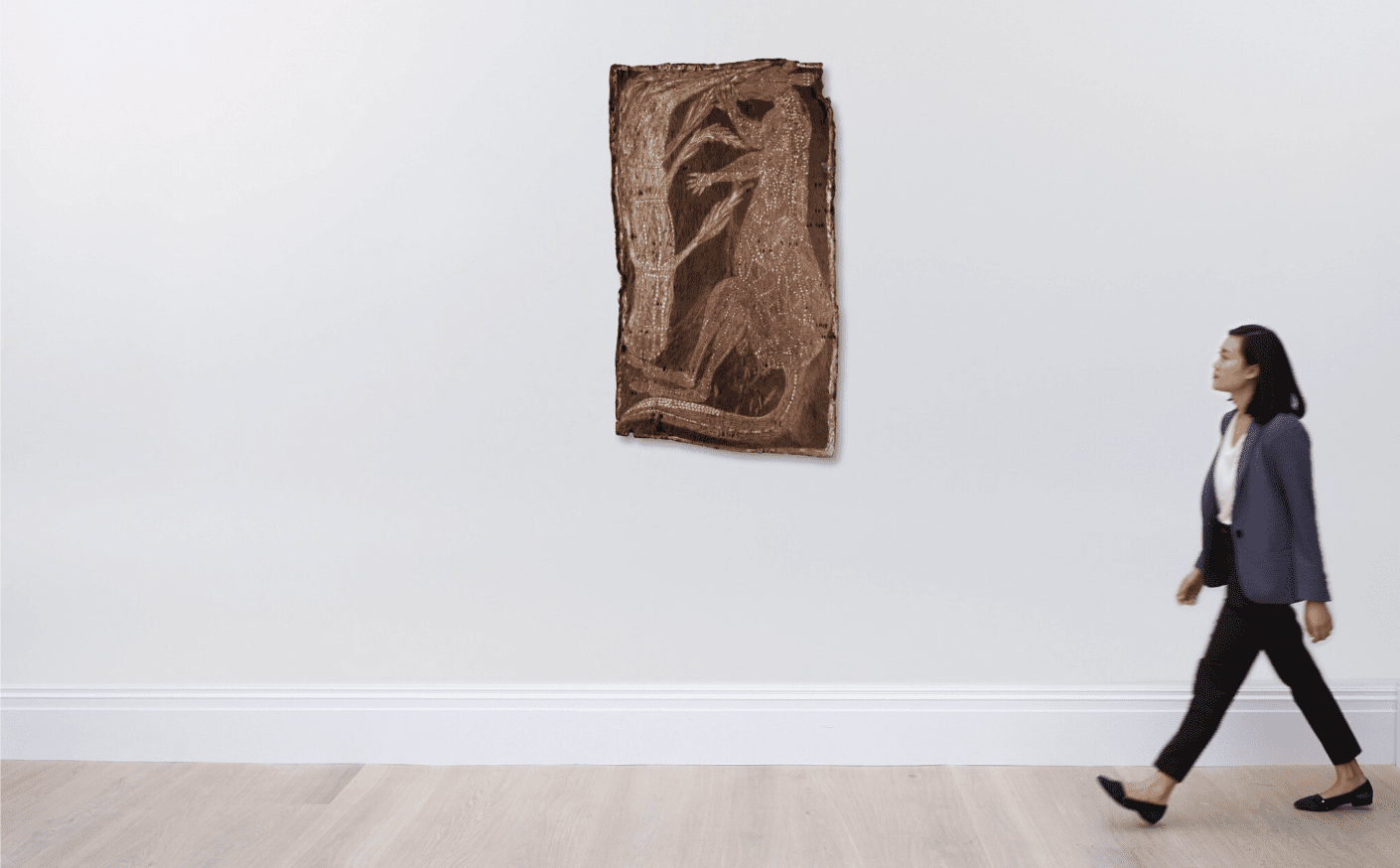
Totemic Animals in Aboriginal art: emu, kangaroo, lizard, rainbow serpent – Each creature tells its Dreaming narrative
Complex geometric symbols and compositions
Spirals: water whirls and spiritual journeys
Spirals in Aboriginal art carry deep symbolic meaning:
Water Whirls In waterholes, whirls sometimes form, creating vortices. These natural phenomena are linked to the presence and power of the Rainbow Serpent.
Tornadoes and Meteorological Phenomena Desert tornadoes (dust devils) appear as spirals, visible manifestations of spiritual forces.
Spiritual Journeys and Transformation The spiral evokes cyclical movement, transformation, and the journey between the earthly world and the spiritual world of the Dreaming.
Nests and Natural Structures Some spirals represent bird nests or other circular natural structures.
Checkerboard and cross-hatching patterns
Checkerboard and cross-hatching patterns frequently appear in Aboriginal art, particularly in specific regional styles:
Reptile Scales These patterns can evoke the scales of the Rainbow Serpent or other totemic reptiles.
Ceremonial Body Paintings The complex geometric patterns applied to the body during ceremonies are transferred onto canvas. Emily Pwerle painted Awelye patterns with checkerboards and interwoven lines.
Land Seen from Above Plots of land, areas of different vegetation, or ceremonial grounds can be represented by colored checkerboards.
Weavings and Basketry Traditional basketry patterns (baskets, woven containers) inspire some geometric compositions.
Cartographic Compositions: Aerial View of the Country
A unique characteristic of Aboriginal art is the aerial perspective. Aboriginal paintings often depict the territory as seen from above, as if the artist were flying over their ancestral country:
Waterholes (circles) distributed across the landscape
Paths (lines) connecting sacred sites
Areas of vegetation (different colors and textures)
Ceremonial sites (major concentric circles)
Locations of Dreaming events marked by specific symbols
This spiritual cartography simultaneously functions as:
Geographical Map of the Physical Territory
Narrative Map of Dreamtime Stories
Ceremonial Map of Sacred Sites
Assertion of Cultural Ownership of Country
Kudditji Kngwarreye, whose works are available at Inma Galerie, created extraordinary aerial visions of his Country near Kintore, with abstract compositions where colors represented seasons and places.

Spiritual Mapping in Aboriginal Art: Aerial View of Ancestral Territory with Waterholes (Circles) and Ancestors' Paths (Lines) - Understanding Compositions with Inma Galerie
Regional Variations of Aboriginal Symbols
The Central Desert: Papunya, Utopia, Gibson Desert
Symbols in Central Desert Aboriginal art (where Papunya, Utopia, Kintore are located) generally follow the system described above: circles, lines, inverted U shapes, and dots. This is the most internationally recognized style, popularized since 1971.
Stylistic Characteristics:
Extensive Use of Dot Painting
Aerial View Cartographic Compositions
Concentric Circles for Waterholes
Palette Dominated by Ochres, Reds, Yellows, Blacks, Whites
Aboriginal artists from Utopia such as Emily Kame Kngwarreye, Gloria Petyarre, and Emily Pwerle, in whom Inma Galerie specializes, have developed personal variations while respecting this fundamental symbolic language.
Arnhem Land: Distinct Symbols and Styles
The Arnhem Land (Northern Australia) possesses its own distinct symbolic traditions:
Rarrk (Cross-hatching) Fine, tightly woven cross-hatching creates textural effects and symbolizes various elements: water, fire, wind, earth. Each clan possesses its specific rarrk patterns.
X-ray Style Animals are depicted transparently, showing their internal organs and bone structure. This unique technique reveals precise anatomical knowledge.
Wandjina (Creator Spirits) In the Kimberley region, Wandjina spirits are depicted with large eyes, no mouth, and halos around their heads.
The APY Lands: Intensity and Innovation
The APY Lands (Anangu Pitjantjatjara Yankunytjatjara, Southern Australia) have developed a vibrant contemporary style while utilizing traditional Aboriginal symbols:
Characteristics:
Intense Colors and Strong Contrasts
Dense compositions with layered motifs
Frequent depiction of the Seven Sisters narrative
Constant technical innovation
Color as Symbol in Aboriginal Art
Symbolic Meanings of Traditional Colors
Beyond their forms, colors in Aboriginal art also hold symbolic dimensions:
Red and Ochre
Earth and Blood
Power of the Creator Ancestors
Fire and Desert Heat
Sacred pigment used in ceremonies
Yellow and Gold
Sun and Light
Transformation and Energy
Desert Sand
Seeds and Food
White
Spirits and Spiritual Dimension
Sky and Clouds
Kaolin (white clay) used ritually
Purity and Sacredness
Black
Night and Mystery
Charcoal used for body paint
Depth and Shadow
Some Creator Ancestors
Blue and Green (in contemporary art) Although not traditional (due to limited natural pigments), these colors are now used to represent:
Water and ocean
Sky and celestial dimension
Contemporary innovation
Regional and seasonal palettes
Aboriginal artists often choose their palettes based on:
The represented location The dominant colors of the specific landscape: red desert, green vegetation after rain, pale sandy soils.
The season The scorching summer (reds, oranges, yellows) vs. the wet season (greens, blues, browns).
The Dreaming narrative Certain stories are traditionally associated with specific palettes.
Kudditji Kngwarreye changed his colors according to the seasons and the places he depicted, creating extraordinary chromatic variations of his ancestral country.
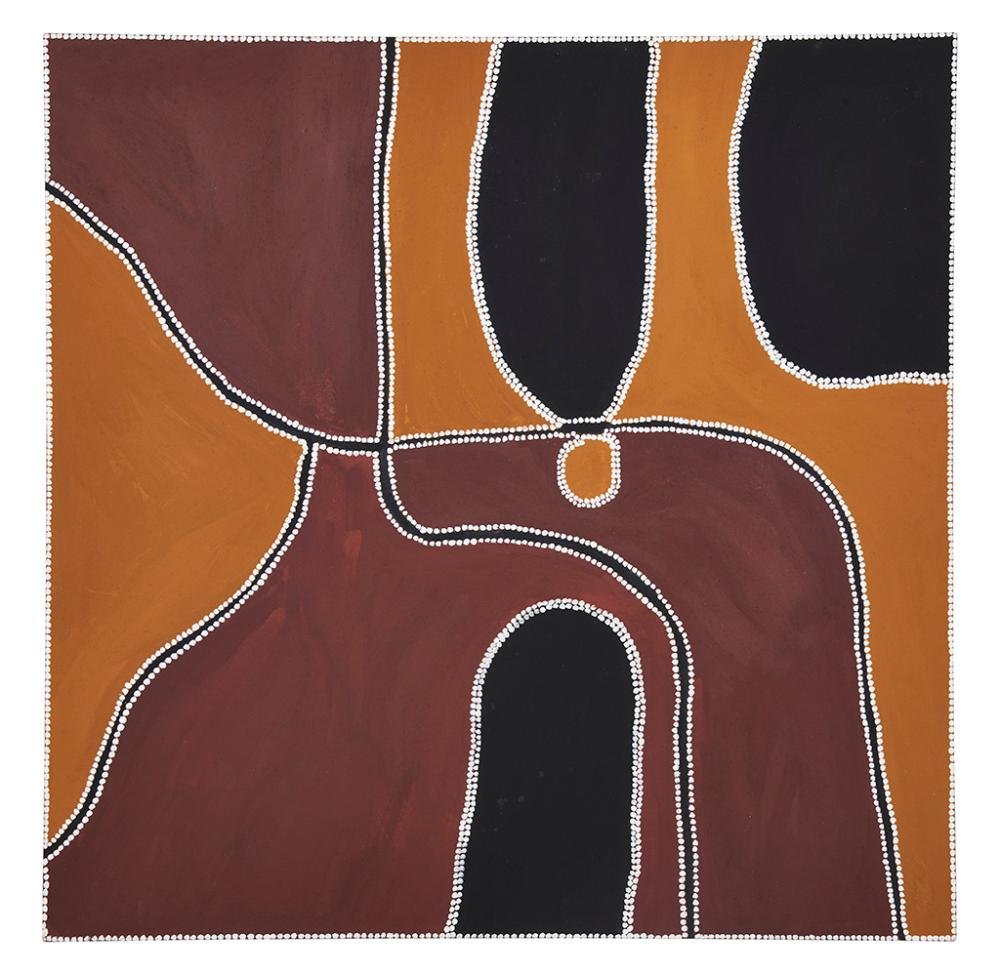
Diversity of palettes in Aboriginal art: from traditional ochres to vibrant contemporary compositions - Each color holds its symbolic meaning
How to read and interpret an Aboriginal painting
Three-level approach
To fully appreciate the symbols in Aboriginal art, adopt a multi-level reading:
Level 1: Recognition of basic symbols Identify fundamental symbols: circles (waterholes), lines (paths), inverted U-shapes (people), animal tracks. This initial reading provides the general narrative framework.
Level 2: Understanding the composition Observe how the symbols are organized: what is the main trajectory? Which sites are connected? What is the narrative structure of the Dreaming story?
Level 3: Knowledge of the specific narrative With the documentation provided by Inma Galerie, understand which specific Dreaming narrative is being told: which Ancestor, what events, what cultural significance.
Questions to ask when viewing an Aboriginal painting
Identification of the artist and region Which community does the artist come from? This influences the style and symbols used. Artists from Utopia have a specific symbolic vocabulary, different from those of Papunya or the APY Lands.
Recognition of perspective Is it an aerial view (cartography) or a more abstract composition? Perspective helps in understanding spatial organization.
Identification of main elements What are the major circles (important sites)? Which lines structure the composition (main paths)? Are there animal or human figures?
Interpretation of the palette Do the colors suggest a season, a specific place, a time of day? Does the palette reinforce the narrative?
Seeking information density Areas densely filled with dots or motifs often indicate places of great spiritual importance. More open spaces can represent the open desert between sacred sites.
Authenticity and Cultural Respect of Symbols
Cultural Ownership of Symbols and Narratives
It is crucial to understand that symbols in Aboriginal art are not in the public domain for free use. Each Dreaming narrative, each symbolic composition, belongs to specific clans, families, and individuals.
Rights of Representation Only Aboriginal artists who possess the appropriate cultural rights are permitted to paint certain narratives. These rights are passed down through heredity and initiation. An artist cannot simply decide to paint any story.
Levels of Revelation Some information contained within Aboriginal paintings is visible to all, while other details are reserved for initiates, and some exclusively for clan members. This stratification protects sacred knowledge.
Cultural Sanctions Painting narratives to which one does not have the right constitutes a serious transgression in Aboriginal culture, potentially leading to social and spiritual sanctions.
Avoiding Cultural Appropriation
As a collector or enthusiast of Aboriginal art, you must be vigilant against cultural appropriation:
Purchase Only from Reputable Sources Specialized galleries like Inma Galerie systematically verify that each artist possesses the right to paint the represented narrative. The certificate of authenticity guarantees this cultural legitimacy.
Reject Imitations Many "Aboriginal-style paintings" are produced by non-Aboriginal people or under unethical conditions (exploitation, unpaid artists). These works use Aboriginal symbols without understanding or respecting their cultural significance.
Learn About the Represented Narrative Always ask for an explanation of the Dreaming narrative. An authentic work is always accompanied by its cultural documentation. At Inma Galerie, each Aboriginal painting includes:
The represented Dreaming narrative
The meaning of the main symbols
The artist's cultural context
The complete certificate of authenticity
Respect Reproduction Restrictions Never reproduce Aboriginal symbols from a work you own without permission. These symbols culturally belong to the artist and their clan.
Symbols in Contemporary Aboriginal Art: Evolution and Innovation
Fidelity and Innovation
Contemporary Aboriginal art demonstrates a remarkable capacity for stylistic innovation while preserving the integrity of traditional symbols:
Increased Abstraction Artists like Kudditji Kngwarreye or Emily Kame Kngwarreye have developed more abstract and gestural styles, moving away from classic dot painting. However, their compositions remain rooted in Dreaming narratives and the symbols of their Country.
Scale and Format Contemporary Aboriginal paintings can reach monumental dimensions impossible with traditional mediums. This amplified scale allows for visual immersion while respecting the ancestral symbolic language.
New Techniques Some Aboriginal artists experiment with new tools (wide brushes, airbrushes, mixed media) while maintaining the traditional symbolic structure. Emily Pwerle used wide brushes to create her expressive Awelye lines.
Contemporary Palettes The introduction of acrylic pigments has expanded the available palette. Vibrant blues, luminous greens, and pinks are not traditional, but the symbols they color remain authentically rooted in the Dreaming.
Innovative Artists and Their Signature Symbols
Emily Kame Kngwarreye (1910-1996) Emily Kame revolutionized Aboriginal art by progressively abandoning explicit symbols for abstract, gestural compositions. Nevertheless, her later "Awelye" works remained representations of women's ceremonies and the medicinal plants of her Country.
Gloria Petyarre (1942-2021) Her "Bush Leaves" compositions utilize thousands of dots to create vibrant surfaces representing medicinal plants. The symbols are simplified (repeated leaf strokes) but their cultural significance remains intact. Discover her works at Inma Galerie.
Kudditji Kngwarreye (1928-2017) Kudditji used large, juxtaposed blocks of color, creating abstract aerial visions of his country, "My Country." Traditional symbols (circles, lines) are suggested rather than explicitly drawn, creating a contemporary spiritual mapping.
Wentja Morgan Napaltjarri (1944-2021) Wentja maintained a more traditional style with concentric circles and dots, but she deliberately created mysterious compositions where much of the Dreaming information remained hidden from the uninitiated.
Collecting Aboriginal art: Understanding Symbols for Informed Choices
Why Understanding Symbols Enriches Your Collection
Collecting Aboriginal art without understanding its symbols is like buying a book in an unknown language: the object remains beautiful, but its content remains inaccessible. Symbolic knowledge transforms your experience:
Narrative Appreciation Each time you view your Aboriginal painting, you reread the narrative of the Dreaming. The artwork never loses its intrigue because it tells a complex story.
Deep Cultural Connection Understanding that this circle represents the sacred waterhole where the Emu Ancestor stopped creates an emotional and intellectual connection with Aboriginal culture.
Educational Conversation You can share the fascinating stories contained within your Aboriginal paintings with your guests, becoming an ambassador for this millennia-old culture.
Heritage Value A documented artwork with a detailed explanation of its symbols possesses superior cultural and market value. Inma Galerie consistently provides this comprehensive documentation.
Essential Questions to Ask Before Purchasing
When considering purchasing Aboriginal art, ask these questions to ensure authenticity and understanding:
What Dreaming narrative is represented? A reputable gallery like Inma Galerie should be able to precisely explain the story being told, not simply state "it's a Dreaming narrative."
What are the main symbols and their meaning? Ask for the identification of visible circles, lines, and other motifs. Each symbol should have an explanation within the context of that specific narrative.
Does the artist have the cultural right to paint this narrative? This crucial question ensures cultural authenticity. The artist must be a member of the appropriate clan or have received permission from the rights holders.
What is the provenance of the artwork? Trace its history from the artist's studio. Authentic artworks originate from community art centers or reputable specialized galleries.
Is there a detailed certificate? The certificate should include: artist's name, artwork title, dimensions, date, explanation of the narrative, artist's photograph if possible, and the stamp of the art center or gallery.
Popular Themes and Symbols to Begin a Collection
Water Dreaming Narratives Compositions centered on concentric circles representing sacred springs. Ideal for understanding Aboriginal spiritual mapping.
Ancestral Journeys (Travelling Dreamings) Artworks depicting paths (lines) connecting different sites. Visual narratives of the movements of the Ancestral creators.
Women's Ceremonies (Awelye) Compositions of lines and geometric motifs representing ritual body paintings. Particularly developed by artists from Utopia.
Animal Totems Paintings centered on a totemic animal (emu, kangaroo, lizard, snake). An excellent entry point for novice collectors.
Bush Leaves and Bush Tucker Representations of medicinal and edible plants. Gloria Petyarre's compositions are emblematic of this theme.
Inma Galerie offers a balanced selection of these various themes, allowing collectors to build a diverse collection while maintaining stylistic coherence.
Preserving and Transmitting: The Documentation of Symbols
The Importance of Comprehensive Documentation
Each Aboriginal painting in the Inma Galerie collection comes with comprehensive documentation that preserves the knowledge of symbols for future generations:
Detailed Technical Sheet
Artist's full name and community of origin
Artwork title (often the name of the Dreaming story)
Dimensions, medium, date of creation
Original Certificate of Authenticity
Cultural Explanation
Depicted Dreaming story (complete narrative)
Meaning of main visible symbols
Cultural and geographical context
Spiritual importance for the community
Traceable provenance (when available)
Original Art Centre or cooperative
History of possession if secondary work
Photographs of the artist working
Conservation Guide
Optimal display conditions
Framing and protection advice
Maintenance recommendations
This documentation transforms a beautiful painting into an authentic cultural testimony whose heritage value is passed on to future generations.
Transmitting the Knowledge of Symbols
As a collector of Aboriginal art, you become a temporary guardian of a fragment of a millennia-old culture. Your responsibility includes:
Educate those around you Share the Dreaming stories and the meaning of the symbols with family, friends, and visitors. Each explanation contributes to the recognition of Aboriginal culture.
Preserve the documentation Carefully preserve all certificates and explanations. If the artwork is resold or passed on, this documentation must accompany it.
Supporting Artists and Communities By purchasing from ethical galleries like Inma Galerie, you ensure that Aboriginal artists are fairly remunerated and that communities benefit economically from their cultural heritage.
Respecting Cultural Restrictions Some information contained within Aboriginal paintings is sacred. Do not attempt to decode or reveal elements that the artist has deliberately kept secret.
Conclusion: Symbols, the Universal Language of Aboriginal Art
Symbols in Aboriginal art are much more than a decorative system: they form a sophisticated visual language that has allowed the transmission of knowledge, laws, and stories for over 65,000 years. Every circle, every line, every dot in an Aboriginal painting carries cultural, spiritual, and narrative significance.
Understanding these Aboriginal symbols radically transforms the experience of both viewer and collector. What might seem abstract suddenly reveals spiritual maps, fascinating mythological narratives, precise ecological knowledge, and sacred ceremonies. Australian Aboriginal art then becomes accessible in all its depth.
At Inma Galerie, specialists in contemporary Aboriginal art, we are passionate about this ancestral symbolic language. Our mission goes beyond simply selling artworks: we are committed to educating our collectors, documenting each Aboriginal painting, and guaranteeing the cultural authenticity of our collection.
Whether you are a novice collector discovering Aboriginal symbols for the first time, or an enlightened enthusiast seeking to deepen your understanding, our experts are available to guide you through the fascinating world of Australian Aboriginal art.
Discover our exclusive collection of authentic Aboriginal art, each artwork accompanied by a detailed explanation of its symbols and the Dreaming narrative it tells.
FAQ: Frequently Asked Questions about Symbols in Aboriginal Art
-
No, although some fundamental symbols (circles for waterholes, lines for paths) are widely shared, regional variations are significant. Symbols in Central Desert art differ from those in Arnhem Land or the Kimberley. Each region, community, and even clan possesses its own symbolic variations. At Inma Galerie, we precisely document the regional origin of each artwork to correctly contextualize its symbols.
-
Artists can innovate stylistically and create personal variations, but they cannot arbitrarily invent new symbols for traditional Dreaming narratives. Fundamental symbols (circles, lines, footprints) are codified by tradition. However, artists like Emily Kame Kngwarreye have developed more abstract approaches where traditional symbols are suggested rather than explicitly drawn, thus creating a contemporary visual language while respecting cultural authenticity.
-
The authenticity of symbols in an Aboriginal painting is verified by several criteria: (1) the artist is an Aboriginal person who is a member of the clan with the right to tell this Dreaming narrative, (2) the symbols used correspond to the conventions of their region and tradition, (3) the gallery provides detailed documentation explaining the narrative and symbols, (4) a certificate of authenticity comes from a community art centre or a reputable gallery like Inma Galerie. Non-Aboriginal imitations often use symbols inconsistently or culturally inappropriately.
-
The dot painting technique serves several functions: historically (since Papunya 1971), dots were used to "fill" the space around sacred symbols, camouflaging certain information from the uninitiated. Symbolically, dots can represent seeds, stars, footprints, or fire. Aesthetically, they create a vibrant texture and visual depth. Culturally, pointillism has become the stylistic signature of Aboriginal art from the Central Desert, although some artists like Kudditji Kngwarreye have deliberately abandoned it for more gestural approaches.
-
This question touches on cultural appropriation. Aboriginal symbols are not in the public domain for free use: they culturally belong to Aboriginal peoples and specifically to the clans who hold the rights to certain narratives. Using these symbols without permission, appropriate cultural context, or benefit to Aboriginal communities constitutes unethical appropriation. If you admire Aboriginal art, the best approach is to purchase authentic artworks from ethical sources like Inma Galerie, thereby directly supporting Aboriginal artists and their communities.
Additional Resources for Further Reading
Recommended Readings on Aboriginal Symbols
To deepen your knowledge of symbols in Aboriginal art, we recommend:
Reference Works:
"Symbolism in Aboriginal Art" (Cambridge University Press)
"Dreamings: The Art of Aboriginal Australia" (George Braziller Publisher)
"Art from the Land: Dialogues with the Kluge-Ruhe Collection of Australian Aboriginal Art"
Documentaries and audiovisual resources: Documentaries such as "Message from Mungo" or "Our Law" explore the connection between symbols, land, and Aboriginal spirituality.
Our Educational Services at Inma Galerie
Personalized Consultations Our Aboriginal art experts offer learning sessions on symbols, tailored to your knowledge level and specific interests.
Exclusive Documentation Each acquisition includes a detailed guide to the symbols present in your Aboriginal painting, prepared by our experts in collaboration with Aboriginal art centers.
About Inma Galerie: Your Specialist in Authentic Aboriginal Art
Inma Galerie stands out as a benchmark in contemporary Aboriginal art through our commitment to cultural authenticity and collector education.
Our Carefully Curated Collection
We exclusively offer authentic Aboriginal paintings from:
Utopia: Emily Kame Kngwarreye, Gloria Petyarre, Emily Pwerle
Gibson Desert: Wentja Morgan Napaltjarri, Kudditji Kngwarreye
Papunya: Historical Works and Contemporary Artists
APY Lands: Emerging and Established Artists
Each Aboriginal painting is selected for its artistic quality, cultural authenticity, and the clarity of its symbols.
Our Guarantee of Authenticity
Inma Galerie is committed to:
Detailed certificates of authenticity for each artwork
Traceable provenance from the art center, gallery, or artist
Comprehensive documentation of symbols and Dreaming narratives
Absolute respect for cultural property and clan rights
Contact us to discover our collection of authentic Aboriginal art and let our experts guide you through the fascinating world of ancestral symbols.