Contemporary Australian Aboriginal Art: A Millennia-Old Heritage in Constant Evolution

The Australian landscape, an inexhaustible source of inspiration for Aboriginal artists who maintain a deep spiritual connection with their ancestral land.
Australian Aboriginal art constitutes one of the oldest uninterrupted artistic traditions in the world. With a history spanning over 65,000 years, this fascinating cultural expression has traversed eras while continually reinventing itself. Today, contemporary Aboriginal art is attracting growing interest on the international art scene, combining respect for ancestral traditions with creative innovations. Let's explore together the many facets of this unique art, its history, its symbols, and its current influence.
The Historical Roots of Australian Aboriginal Art
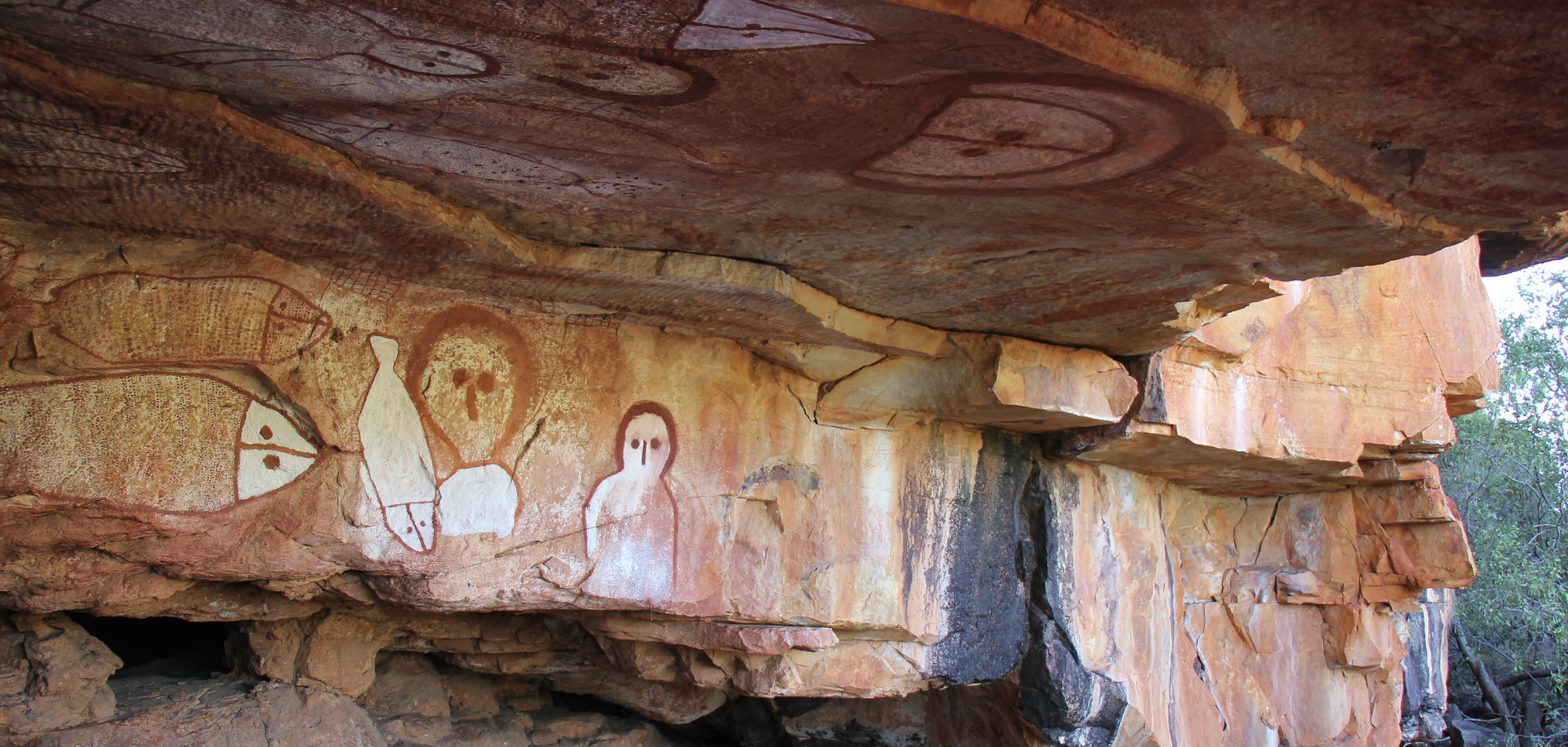
Wandjina rock paintings in the Kimberley region, dating back thousands of years. These representations of ancestral beings constitute one of humanity's oldest artistic expressions.
A Millennia-Old Tradition
The Aboriginal peoples of Australia constitute one of the world's oldest civilizations. Their presence on the Australian continent dates back over 65,000 years, a period during which they developed a rich and complex culture, intimately linked to their environment. Art, a central element of this culture, initially served as a medium for the oral transmission of ancestral knowledge, beliefs, and stories.
The earliest Aboriginal artistic expressions are found in rock paintings scattered across the continent. The Kimberley region, in northwestern Australia, is home to some of the oldest known paintings, dating back over 40,000 years. These works often depict anthropomorphic figures, animals, or geometric patterns, already demonstrating great technical mastery and elaborate symbolism.
The "Dreamtime": Spiritual Foundation of Aboriginal Art
To understand Aboriginal art, it is essential to grasp the concept of the "Dreamtime" (Tjukurrpa in Pitjantjatjara language or Jukurrpa in Warlpiri). This complex notion refers both to the period of the world's creation by ancestral beings and to the body of laws, knowledge, and practices that govern the life of Aboriginal communities.
The Dreamtime transcends the Western concept of linear time: it is simultaneously past, present, and future, forming an omnipresent spiritual framework. Dreamtime narratives explain the formation of the landscape, the origin of plants and animals, as well as the social relationships and ceremonial obligations of different Aboriginal groups.
Traditional Aboriginal art is therefore much more than a simple aesthetic expression: it represents a spiritual mapping of the territory, a complex system for transmitting knowledge, and a means of keeping the connection with ancestors alive.

Spiritual mapping of an Aboriginal territory. Each motif tells the story of the ancestral beings who shaped the landscape during the Dreamtime.
Did you know? Body painting is one of the oldest forms of Aboriginal artistic expression. During traditional ceremonies, participants cover their bodies with symbolic patterns made with natural pigments, thus creating ephemeral works of great complexity. These body designs, which vary according to regions and occasions, are intimately linked to Dreamtime narratives and the clan identity of individuals.
The Renaissance of Aboriginal Art in the 1970s
The Papunya Tula Art Movement
While Aboriginal art has existed for millennia, its recognition by the Western world is relatively recent. A major turning point occurred in the 1970s with the emergence of the Papunya Tula art movement in the central Australian desert.
In 1971, teacher Geoffrey Bardon encouraged a group of Aboriginal men from the Papunya community to paint their traditional stories on permanent supports. Accustomed to creating ephemeral ground paintings for ceremonies, these artists began to transfer their designs onto wooden boards, and then onto canvases. This initiative marked the birth of the Central Desert dot painting movement, which would achieve resounding success.
Pioneering artists such as Clifford Possum Tjapaltjarri, Johnny Warangkula Tjupurrula, and Kaapa Tjampitjinpa developed a recognizable style characterized by the use of meticulous dots to create complex compositions representing Dreamtime narratives. These works, initially sold at low prices, are now considered masterpieces of contemporary Aboriginal art and fetch considerable sums on the art market.
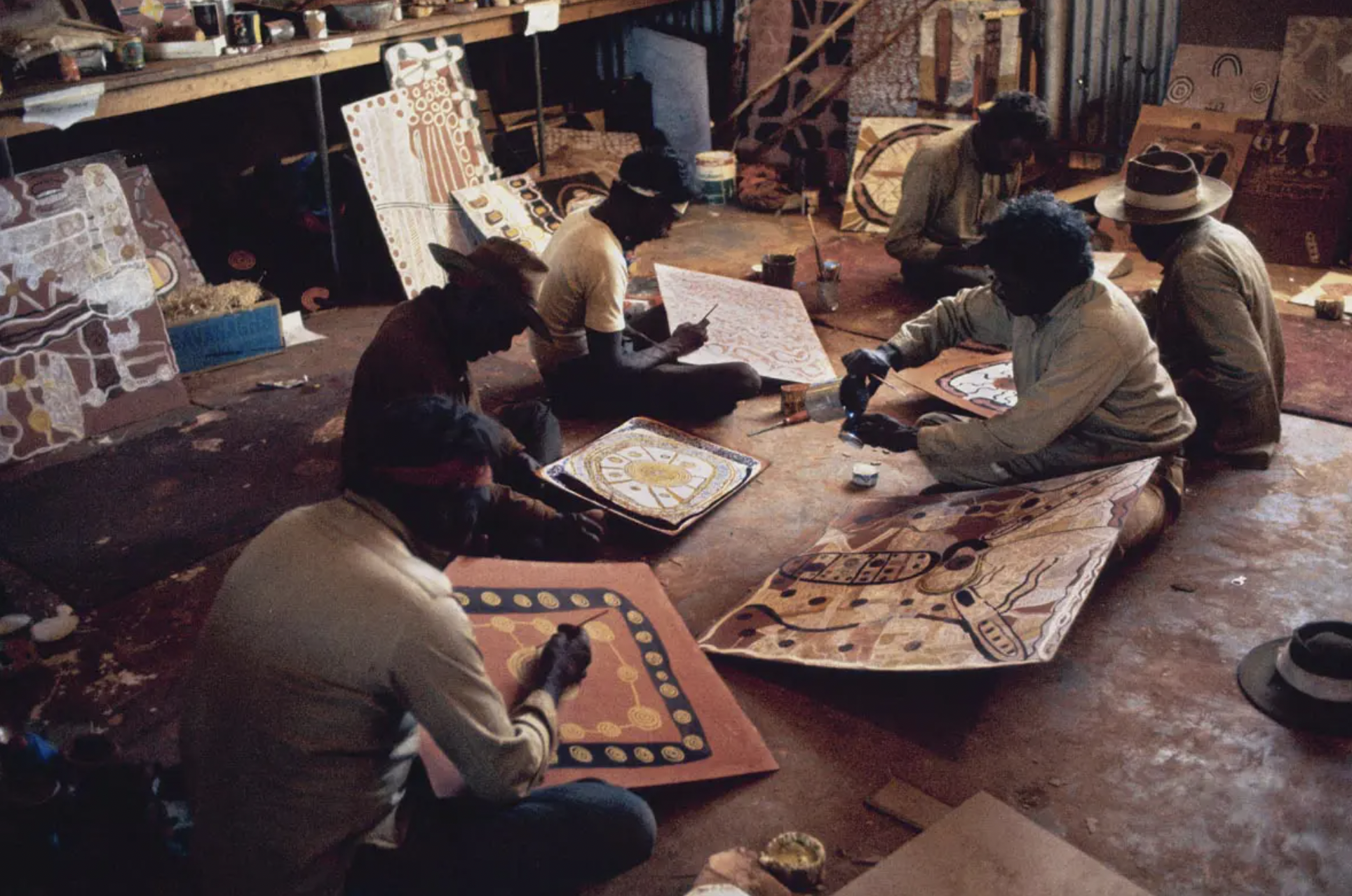
The first generation of Papunya Tula artists painting in the Papunya workshop, 1971 (Photo by Michael Jensen).
The Diversification of Art Centres
Following the success of the Papunya Tula movement, numerous Aboriginal art centres emerged across Australia in the 1980s and 1990s. Each region developed its own artistic style, reflecting local cultural and environmental specificities:
In Arnhem Land, in the north of the country, artists like John Mawurndjul perpetuated the tradition of rarrk, an extremely fine cross-hatching technique, to represent ancestral beings and sacred sites.
In Utopia, northeast of Alice Springs, female artists like Emily Kame Kngwarreye developed a freer and more expressive style, often linked to women's ceremonies and knowledge of plants.
In the Kimberley region, artists have created a distinctive style using natural ochre pigments to represent the spectacular landscapes of this area.
On Bathurst Island, Tiwi artists have developed a unique visual language combining traditional motifs and contemporary innovations.
This diversification has considerably enriched the Aboriginal art landscape, offering a multiplicity of expressions and techniques that attest to the vitality of this cultural tradition.
Symbols and Techniques of Contemporary Aboriginal Art
A Codified Visual Language
Aboriginal art is based on a complex system of symbols used to tell stories and transmit knowledge. Each community possesses its own repertoire of motifs, the meaning of which can vary depending on the context. Among the commonly used symbols are:
Concentric circles, which can represent a waterhole, a sacred site, or a campsite.
Undulating parallel lines, often evoking movement, rivers, or paths taken by ancestral beings.
Animal tracks, identifiable by their characteristic shape (kangaroo, emu, goanna, etc.).
U-shapes, generally symbolizing seated people.
Dots, which can serve to conceal sacred information or to represent stars, seeds, or rain.
Reading an Aboriginal artwork therefore requires in-depth knowledge of these visual codes, some aspects of which remain deliberately hidden from the uninitiated, thus preserving the sacred nature of certain narratives.
Techniques and Materials

Detail of an artwork using the 'dot painting' technique. This meticulous method allows for the creation of complex motifs while veiling certain sacred aspects of ancestral narratives. Anatjari (Yanyatjarri) Tjakamarra, Kirritjinya, 1989.
Contemporary Aboriginal art is characterized by a great diversity of techniques and materials, attesting to both a grounding in tradition and an openness to innovation:
Dot painting: This emblematic technique involves meticulously applying dots of color to create complex motifs. Traditionally created with natural pigments, it often uses vibrant acrylic paints today.
Rarrk: Practiced mainly in Arnhem Land, this technique of extremely fine cross-hatching requires great dexterity. It is traditionally created with natural pigments applied using a chewed stick to form a brush.
Bark painting: Eucalyptus bark, previously prepared and flattened, serves as a support for paintings created with natural pigments. This tradition, particularly vibrant in Arnhem Land, produces works of great finesse.
Sculpture: Wooden sculptures, funerary totems (pukumani) from the Tiwi Islands, or natural fiber figures attest to the richness of Aboriginal three-dimensional expressions.
Mixed media: Many contemporary artists explore innovative combinations of materials and techniques, sometimes incorporating modern elements while preserving the spiritual essence of their art.
This technical diversity contributes to the visual richness of contemporary Aboriginal art, which constantly oscillates between tradition and innovation.
Technical Focus: Natural Pigments
Before the introduction of acrylic paints, Aboriginal artists exclusively used natural pigments for their creations. Red, yellow, and white ochre, charcoal for black, and various colored clays were extracted from specific, often sacred, sites. The preparation of these pigments followed precise protocols, and their application required ancestral expertise. Today, some contemporary artists are returning to these traditional materials, creating a bridge between ancestral practices and modern expressions.

Eucalyptus bark painting using the rarrk (cross-hatching) technique, characteristic of Arnhem Land art.
Major Figures in Contemporary Aboriginal Art
From Pioneers to Current Artists
Contemporary Aboriginal art features many iconic figures who have contributed to its international recognition:
Emily Kame Kngwarreye (c. 1910-1996) is undoubtedly the most internationally renowned Aboriginal artist. Hailing from the Utopia community, she began her artistic career at the age of 80 and in eight years produced over 3,000 works of extraordinary stylistic diversity. Her abstract canvases, inspired by her homeland and ceremonies related to wild yam seeds, revolutionized the perception of Aboriginal art.

Emily Kame Kngwarreye in her studio in Utopia in 1995. Beginning her artistic career at 80, she became one of the most recognized Aboriginal artists worldwide.
Clifford Possum Tjapaltjarri (c. 1932-2002), one of the founders of the Papunya Tula movement, is known for his complex and meticulous compositions depicting multiple Dreamtime stories simultaneously. His work "Warlugulong" was sold in 2007 for a record sum of 2.4 million Australian dollars.
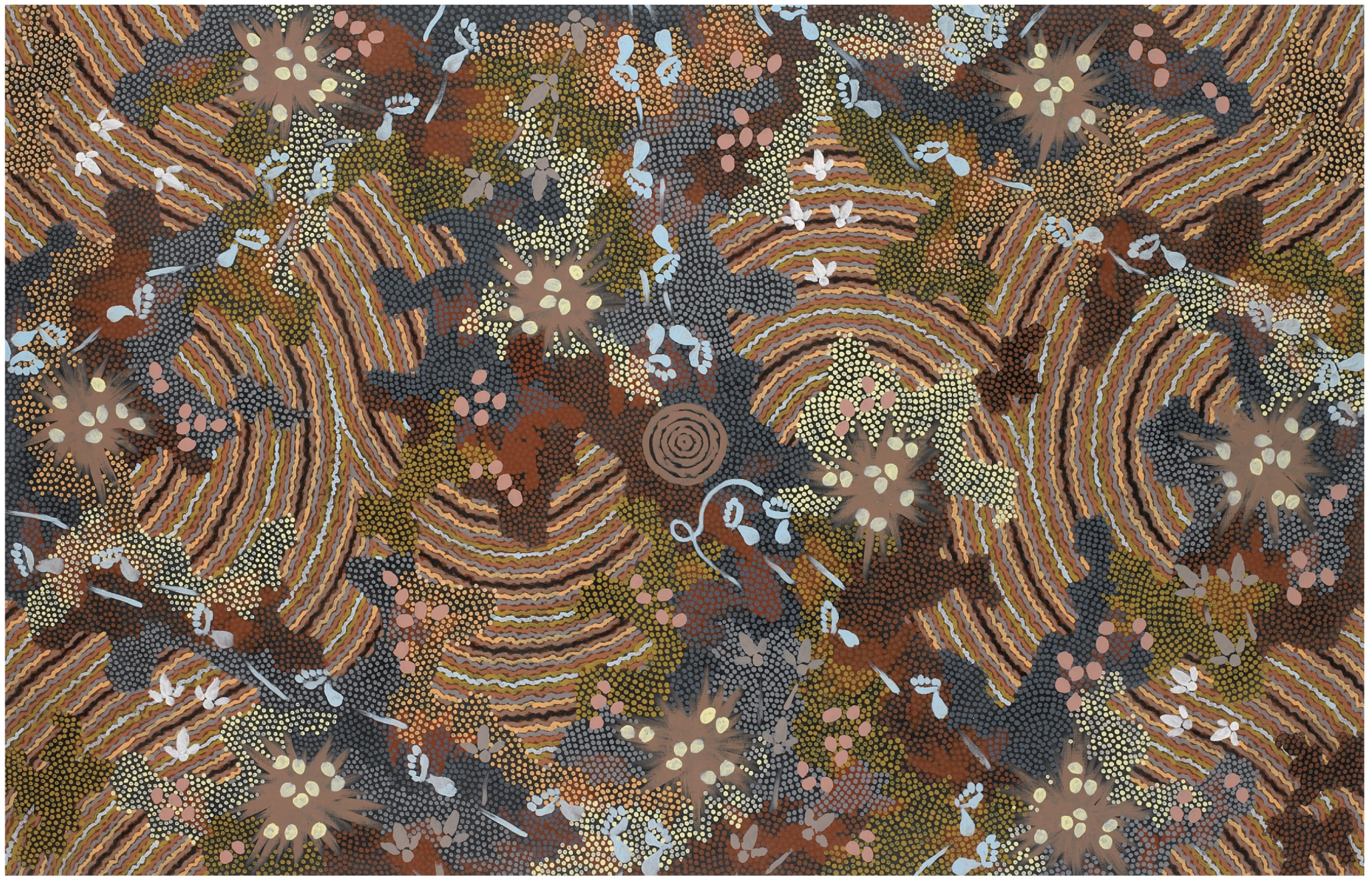
A work by Clifford Possum Tjapaltjarri depicting multiple Dreamtime stories simultaneously. Its complex composition reflects the artist's profound cultural knowledge.
Albert Namatjira (1902-1959), though predating the contemporary movement, paved the way by becoming the first Aboriginal artist recognized by the Western public. His watercolors depicting the landscapes of central Australia in a realistic style achieved immense success and continue to inspire many artists from the Hermannsburg community today.
John Mawurndjul (born 1952), originally from Arnhem Land, is renowned for his exceptional mastery of the rarrk technique and his contemporary interpretation of traditional motifs. His work has been featured in major international exhibitions, notably at the Musée du quai Branly in Paris.
Dorothy Napangardi (c. 1956-2013) developed a distinctive style characterized by intersecting white lines on a black background, representing the salt of Lake Mackay and the ancestral stories linked to this sacred site. Her works, of great subtlety, have been exhibited worldwide.
Sally Gabori (c. 1924-2015), originally from Bentinck Island in the Gulf of Carpentaria, began painting at the age of 80 and was quickly recognized for her vibrant abstract compositions depicting her homeland. Her unique, free, and expressive style reflects a very personal approach to painting.
These artists, and many others, have contributed to making contemporary Aboriginal art a major artistic movement, recognized and appreciated internationally.
« When I paint, I don't just create an image. I tell the story of my country, I show the sacred sites entrusted to me by my ancestors. Every line has meaning, every motif is linked to a story that goes back to the beginning of time. My art is my way of keeping this connection to my origins alive and passing it on to future generations. It is both an act of creation and a spiritual duty. »
The New Generation
A new generation of contemporary Aboriginal artists continues this tradition today while enriching it with new perspectives. These creators, often trained in Western art institutions, navigate between multiple cultural worlds and explore various mediums:
Brook Andrew uses photography, video, and installations to question colonial representations of Aboriginal peoples and offer a critical reinterpretation of Australian history.

Multimedia installation by artist Brook Andrew, which combines traditional Aboriginal references and contemporary aesthetics to question Australian colonial history.
Judy Watson combines traditional techniques and contemporary approaches to evoke the history of her ancestors and current environmental issues.
Daniel Boyd reinterprets historical colonial images through an Aboriginal lens, creating works that challenge dominant narratives.
Yhonnie Scarce works with blown glass to create powerful installations evoking the impact of British nuclear tests on Aboriginal lands.
Vincent Namatjira (great-grandson of Albert Namatjira) paints satirical portraits of political and historical figures, humorously commenting on power relations in contemporary Australia.
These artists, while remaining connected to their cultural heritage, address contemporary themes such as identity, colonization, the environment, or politics, thereby making a significant contribution to current debates.
Aboriginal Art on the International Stage
Growing Recognition
Since the 1980s, Australian Aboriginal art has gained increasing international recognition, marked by major exhibitions in the world's leading museum institutions:
In 1988, the exhibition "Dreamings: The Art of Aboriginal Australia" at the Asia Society Museum in New York marked a significant milestone in the recognition of Aboriginal art in the United States.
In 1989, the "Magiciens de la Terre" exhibition at the Centre Pompidou in Paris featured several Aboriginal artists, contributing to their visibility in Europe.
In 2000, a monumental installation of Aboriginal paintings was presented at the opening of the Sydney Olympic Games, asserting the central place of this art in Australian cultural identity.
In 2006, the Musée du quai Branly in Paris unveiled a permanent installation of Aboriginal artworks on its ceilings and facades, marking a major institutional recognition.
In 2013, the "Australia" exhibition at the Royal Academy of Arts in London presented a comprehensive overview of Australian art, giving significant prominence to Aboriginal artists.
These events, among others, have helped introduce Aboriginal art to an international audience and affirm its place in global art history.

The ceiling of the Musée du quai Branly in Paris, adorned with Aboriginal artworks. This permanent installation, inaugurated in 2006, testifies to the international recognition of this art.
The Aboriginal Art Market
The Aboriginal art market has experienced significant growth in recent decades, with artworks reaching record prices in international auctions. In 2007, Emily Kame Kngwarreye's painting "Earth's Creation" sold for 1.056 million Australian dollars, setting a record for an Aboriginal artwork at the time.
This economic valuation has had mixed effects. On one hand, it has led to greater recognition for Aboriginal artists and generated significant income for some isolated communities. On the other hand, it has also led to issues of exploitation, counterfeiting, and cultural appropriation.
To address these challenges, the Australian government has implemented initiatives such as the Indigenous Art Code, aimed at ensuring ethical practices in the Aboriginal art trade. Labels like that of the Aboriginal Art Centre of Australia (AAA) certify the authenticity of artworks and ensure fair remuneration for artists.
Contemporary Challenges in Aboriginal Art
Between Cultural Preservation and Artistic Innovation
Contemporary Aboriginal art stands at the crossroads of several fundamental challenges. On one hand, it plays an essential role in the preservation and transmission of traditional Aboriginal cultures, which have been threatened by centuries of colonization and forced assimilation. Community art centers, often located in isolated regions, provide vital spaces where traditional knowledge can be shared between generations.
On the other hand, this art is constantly evolving, integrating new influences, techniques, and themes. This dynamic of innovation allows Aboriginal artists to respond to the challenges of the contemporary world while maintaining a deep connection to their cultural heritage.
This dialogue between tradition and innovation is one of the strengths of contemporary Aboriginal art, enabling it to remain relevant and vibrant in a constantly changing global context.
Issues of Cultural Appropriation
The growing popularity of Aboriginal art has raised important questions regarding cultural appropriation. The use of Aboriginal motifs on commercial products without authorization or compensation represents a major problem. Similarly, the production of fake "Aboriginal art" for the tourist market – sometimes manufactured in Asia or elsewhere – constitutes a form of cultural and economic exploitation.
These practices are all the more problematic because many Aboriginal motifs are linked to sacred stories and can traditionally only be represented by individuals with the cultural authority to do so. The inappropriate use of these motifs can therefore constitute a serious spiritual violation.
In response to these challenges, initiatives such as the "Authentic Aboriginal Art" label have been developed to help consumers identify ethically produced artworks by Aboriginal artists. Discussions are also underway to strengthen the legal protection of traditional cultural expressions, which are currently inadequately covered by intellectual property laws.
Collecting Contemporary Aboriginal Art: Tips and Best Practices

Community Aboriginal art center where artists work collectively. These centers play a crucial role in the ethical production and distribution of Aboriginal art.
Choosing Authentic and Ethical Artworks
For art enthusiasts wishing to acquire contemporary Aboriginal artworks, it is essential to adopt a responsible and ethical approach:
Prioritize reliable sources: Purchasing from recognized specialized galleries, community Aboriginal art centers, or at events like the Darwin Aboriginal Art Fair generally guarantees the authenticity of the artworks and fair remuneration for the artists.
Verify provenance: An authentic artwork comes with a certificate detailing its origin, the artist's identity, their community, and the story represented in the artwork.
Learn about the artists: Understanding an artist's journey, their community of origin, and the cultural context of their work significantly enriches the collecting experience.
Be mindful of prices: Works offered at unusually low prices may indicate inauthentic production or unfair remuneration conditions for artists.
Look for quality labels: Labels such as those from the Association of Aboriginal Art Centres (ANKAAA) or the Indigenous Art Code attest to ethical commercial practices.
By following these recommendations, collectors contribute to supporting a sustainable art ecosystem that respects Aboriginal cultures.
Preserving and showcasing artworks
Contemporary Aboriginal art requires appropriate conservation conditions to preserve its integrity long-term:
Acrylic paintings on canvas must be protected from direct sunlight exposure, which could alter their vibrant colors.
Works on bark or made from natural materials are particularly sensitive to humidity variations and may require specific climate control.
Framing of artworks must be carried out by professionals using acid-free materials to prevent any deterioration.
For optimal display, it is recommended to consider the cultural significance of the artwork during its installation. Some pieces may have been designed to be viewed from a particular angle or in a specific context.
Glossary of Aboriginal Art
Tjukurpa/Jukurrpa: The Dreamtime, a fundamental spiritual concept
Rarrk: Cross-hatching technique characteristic of Arnhem Land
Pukumani: Carved funerary poles from the Tiwi Islands
Dreamings: Ancestral narratives linked to a specific territory
Songlines: Mythical routes marking the passage of ancestral beings
Country: A concept designating a group's traditional territory, including its physical, spiritual, and cultural dimensions
Conclusion: A living art rooted in a millennia-old history
Contemporary Australian Aboriginal art is a remarkable artistic phenomenon, combining one of the world's oldest cultural traditions with a constantly evolving creative expression. Far more than a mere aesthetic movement, it represents a powerful means of preserving and transmitting millennia-old knowledge, while affirming the vitality of Aboriginal cultures in present-day Australia.
For collectors and art enthusiasts, contemporary Aboriginal art offers a unique opportunity to connect with a worldview profoundly different from the Western perspective. Its complex motifs, vibrant colors, and ancestral narratives invite us to rethink our relationship with time, space, and spirituality.
By supporting this art ethically and knowledgeably, we contribute not only to its longevity but also to the recognition of the extraordinary cultural richness of Australia's first inhabitants.
Discover our selection of contemporary Australian Aboriginal artworks in our online gallery. Authentic and certified pieces, carefully selected for their artistic quality and cultural significance. Our team of specialists is available to advise you on your acquisition process.